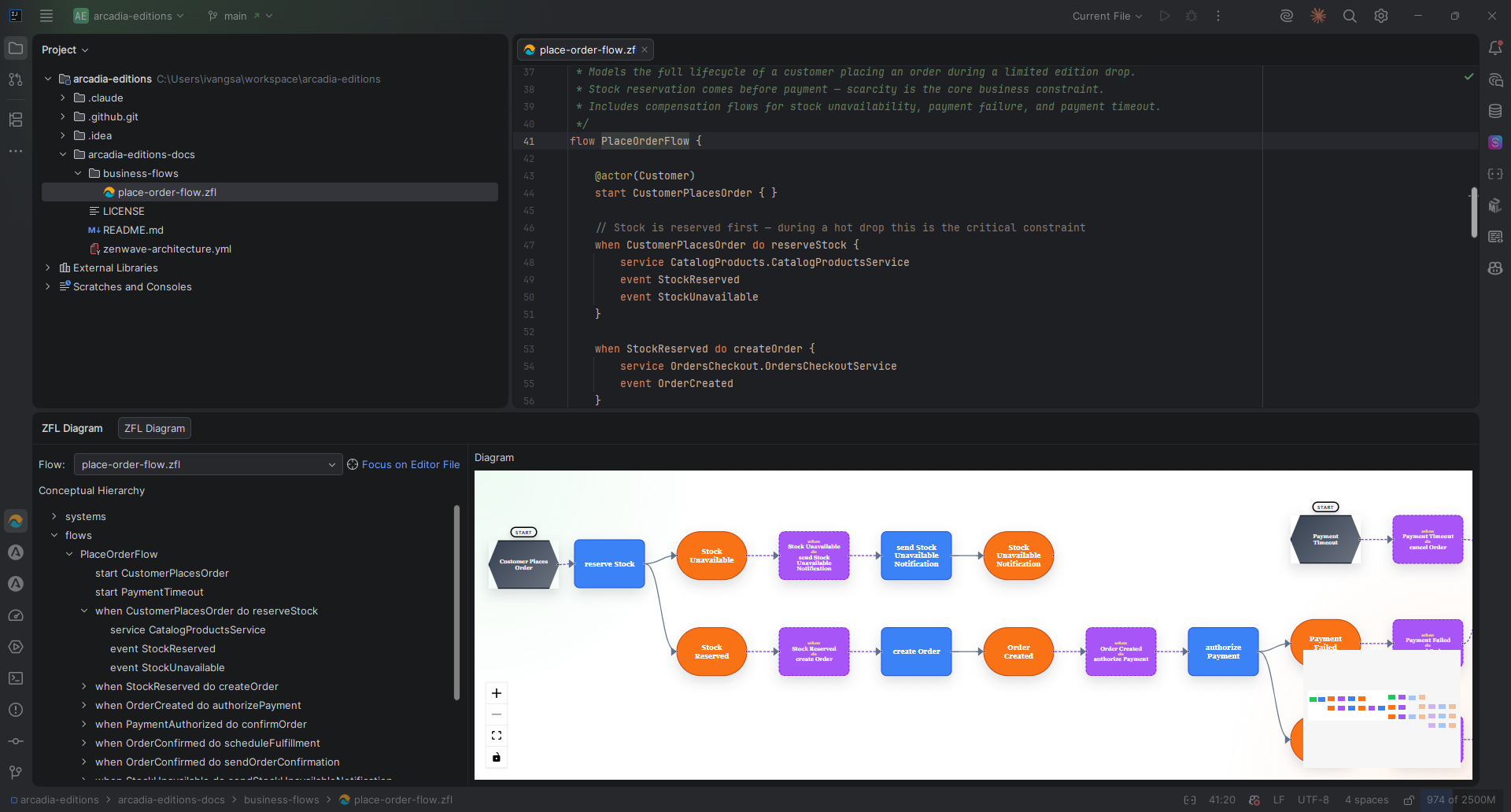
In the previous post we ran an Event Storming session for the PlaceOrder flow of Arcadia Editions. We have the board. We have the sticky notes. We understand what happens when a collector clicks reserve during a hot drop.
Now we need to give those findings a structured home.
Event Storming sessions often end as Miro boards, photos, and shared memory. Useful in the workshop. Hard to version. Hard to search. Hard to connect to generated APIs, services, tests, documentation, or architecture views.
ZFL, the flow modeling language of the ZenWave Platform, captures the same findings as text: readable by humans, parseable by tools, and stable enough to save, link, review, and navigate.
This post is about that translation. Not discovering the flow again, but taking the board we already have and turning it into a structured language.
The core idea: Event Storming and ZFL speak the same language
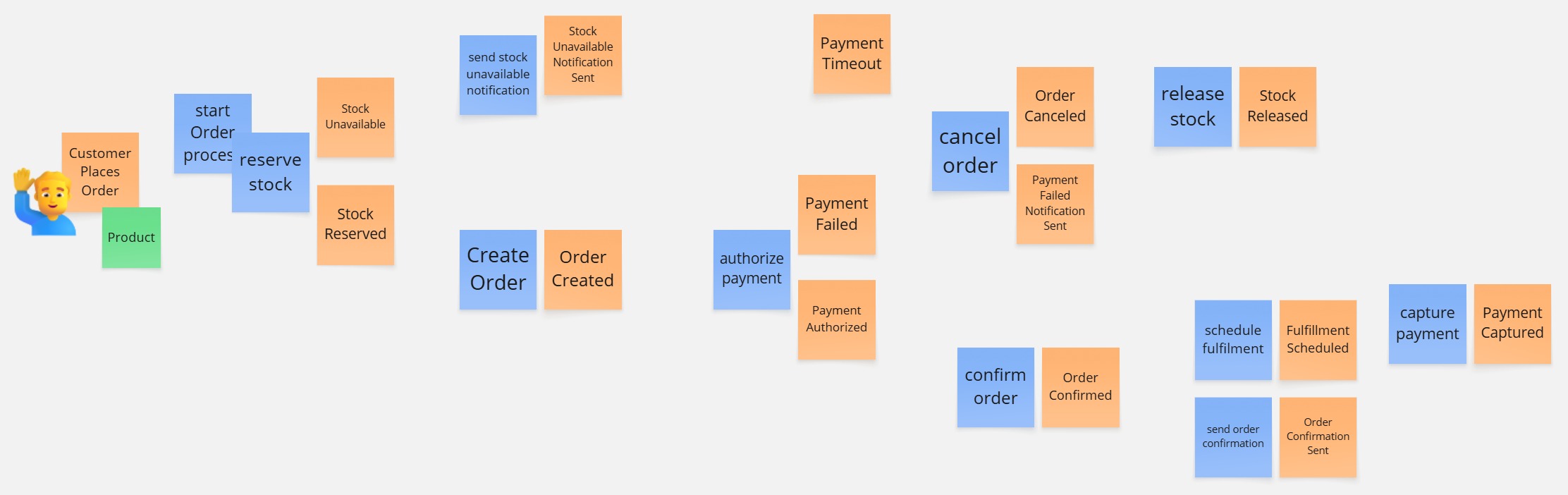
Event Storming has four core concepts that we care about here.
-
An event is something that happened in the business. Past tense.
OrderCreated.StockReserved.PaymentFailed. Orange sticky notes. -
A command is something that asks the system to do work. An intention.
ReserveStock.AuthorizePayment.SendOrderConfirmation. Blue sticky notes. -
A policy is a business rule that connects an event to a command. When this happens, do that. Lilac sticky notes. This is where the business logic lives.
-
An actor is who or what initiates the first command. A customer. A timer. An external system.
ZFL maps directly to these concepts. Once you see the mapping, reading and writing ZFL from an Event Storming board becomes mechanical.
| Event Storming | ZFL |
|---|---|
| Actor | @actor |
| Starting trigger / user intent | start |
| Policy: when trigger or event, do command | when ... do ... |
| Command outcome | emits ... |
| Timer / time-based policy | @time(...) + start |
| End states | end { ... } |
Start with the actor
On the board, the flow starts with a customer beginning checkout. That is an actor triggering the first command.
In ZFL:
@actor(Customer)
start StartOrderCheckout {
    items SKU[]
}
@actor names who initiates the flow. start names the trigger or user intent that opens it. The body contains the data that enters the flow.
The actual command still appears in the first policy:
when StartOrderCheckout do startOrderCheckout {
    ...
}
StartOrderCheckout is why the flow begins. startOrderCheckout is the command that reacts to it.
Policies are the main building block
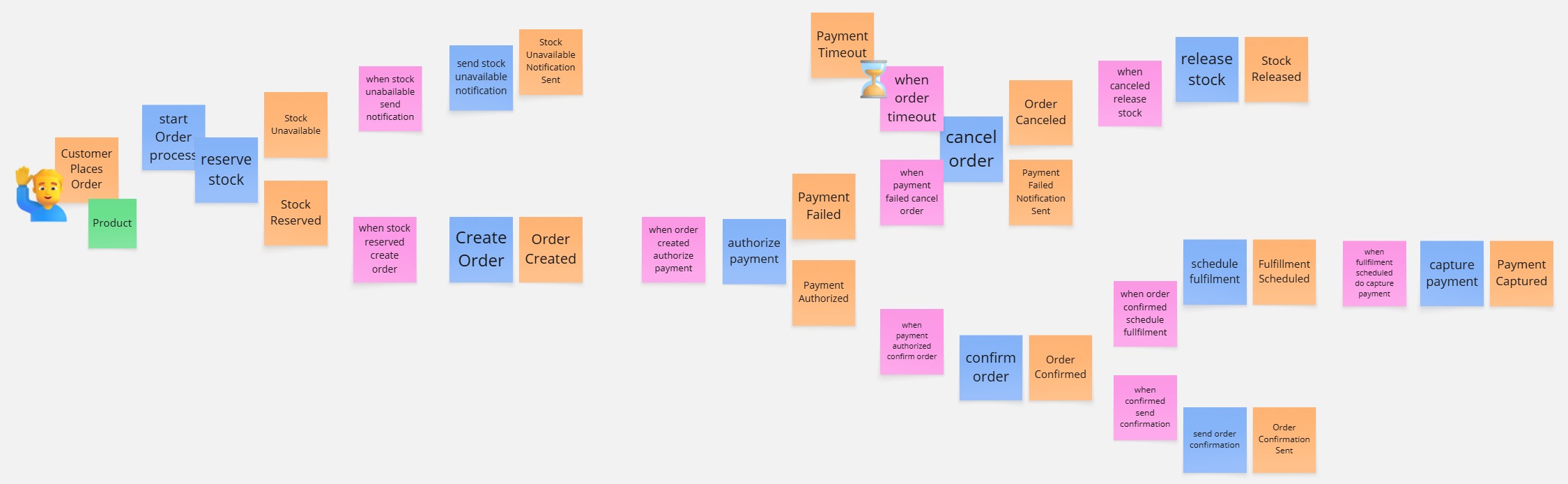
This is where Event Storming and ZFL align most clearly. Every policy on the board, “when this event happens, do this command”, becomes a when ... do ... block.
For example, once an order has been created, payment needs to be authorized:
when OrderCreated do authorizePayment {
    service PaymentsProcessing.PaymentsProcessingService
    emits PaymentAuthorized
    emits PaymentDeclined
    emits PaymentFailed
}
The when side is the event that triggers the policy. The do side is the command. The emits lines are the possible outcomes of that command.
You will also see service lines in some examples. They belong to a later modeling step, when we discover bounded contexts, systems, services, and aggregates. The notation can go up to System.Service.Aggregate, but you only write the level you have already discovered. At this stage, it is also fine to omit service completely.
This is the default move when translating an Event Storming board into ZFL:
- Find a policy sticky note.
- Read the event before it.
- Read the command after it.
- Write
when Event do command. - Add the events that command can emit.
From there, the flow chains naturally. Each outcome can trigger the next policy.
when PaymentAuthorized do confirmOrder {
    service OrdersCheckout.OrdersCheckoutService
    emits OrderConfirmed
}

when OrderConfirmed do scheduleFulfillment {
    service FulfillmentShipping.FulfillmentShippingService
    emits FulfillmentScheduled
    emits FulfillmentFailed
}

when FulfillmentScheduled do capturePayment {
    service PaymentsProcessing.PaymentsProcessingService
    emits PaymentCaptured
    emits PaymentCaptureFailed
}
If the Event Storming board is the visual story, ZFL is the structured version of that same story.
Branches stay explicit
Event Storming does not let you hide failure paths. When you ask “what can go wrong?”, the board fills up. ZFL keeps those branches visible.
Payment authorization can succeed, be declined, or fail for a technical reason. Each outcome is named:
when OrderCreated do authorizePayment {
    service PaymentsProcessing.PaymentsProcessingService
    emits PaymentAuthorized
    emits PaymentDeclined
    emits PaymentFailed
}
Then each outcome can continue in a different direction:
when PaymentFailed do retryPayment {
    service PaymentsProcessing.PaymentsProcessingService
    emits PaymentRetried
    emits PaymentRetryExhausted
}

when PaymentDeclined, PaymentRetryExhausted do releaseStock {
    service CatalogInventory.InventoryService
    emits StockReleased
}
This is one of the reasons a text model is useful. The board helps the team discover the branches. ZFL keeps them precise enough for tools to analyze, generate from, and cross-navigate.
Direct calls
Most policies translate cleanly as event-to-command relationships. But when we turn a workshop board into a structured model, we sometimes discover that a step should be modeled as a direct synchronous call.
Stock reservation is the clearest example in this flow.
When a customer starts checkout during a limited edition drop, we want to know immediately whether the stock can be reserved. We do not want to model that as a long event-driven loop just to find out whether the copy is available. The checkout command needs the response now, because the next step depends on it.
ZFL models that with call:
when StartOrderCheckout do startOrderCheckout {
    service OrdersCheckout.OrdersCheckoutService
    call reserveStock
    on StockReserved emits OrderCreated
    on StockUnavailable emits StockUnavailable
}
The policy is still there: when StartOrderCheckout, do startOrderCheckout. Inside that command, we make a direct call to reserveStock.
The response of that call is handled with on <Response> emits .... If stock is reserved, the flow emits OrderCreated. If stock is unavailable, the flow emits StockUnavailable.
The called operation is modeled separately:
do reserveStock {
    service CatalogInventory.InventoryService
    emits response StockReserved
    response StockUnavailable
}
A standalone do block defines a command that can be called directly. Its outcomes are response values because the caller is waiting for them.
Sometimes the response is also important outside the caller. emits response StockReserved means the caller receives StockReserved synchronously, and the same outcome is published as an event for the rest of the system. StockUnavailable stays only as a response because no order was created and there is nothing else to coordinate.
The important modeling rule stays simple: use when ... do ... for policies, and use call when the structured model needs an immediate response from another command.
Time-based policies
Event Storming also surfaces rules that happen after time passes. A customer who starts checkout and never finishes is not an edge case for Arcadia Editions. During a drop, holding stock forever is business damage.
On the board, this is a time-based policy. After ten minutes without a terminal payment outcome, the reservation expires.
ZFL has a @time annotation for exactly this:
@actor(Scheduler)
@time("10 minutes after OrderCreated and not PaymentAuthorized or PaymentDeclined or PaymentRetryExhausted")
start ReservationExpired {
    orderId String
}
@time defines the condition. start names the event produced by the scheduler. From there it behaves like any other event in the flow:
when ReservationExpired do releaseStock {
    service CatalogInventory.InventoryService
    emits StockReleased
}
The timing rule from the workshop is no longer just a note on the side of the board. It is part of the model.
End states
Every Event Storming session needs to answer: how does this flow end? What are the possible final states?
ZFL makes this explicit with an end block:
end {
    completed: PaymentCaptured
    stockGone: StockUnavailableNotificationSent
    orderCancelled: OrderCancelledNotificationSent
}
Each ending gets a name. Each one points to an event in the flow. That gives readers and tools a clear set of terminal outcomes.
The full flow
Put it all together and the ZFL model has this shape:
flow PlaceOrderFlow {
    @actor(Customer)
    start StartOrderCheckout {
        ...
    }

    when StartOrderCheckout do startOrderCheckout {
        call reserveStock
        on StockReserved emits OrderCreated
        on StockUnavailable emits StockUnavailable
    }

    do reserveStock {
        service CatalogInventory.InventoryService
        emits response StockReserved
        response StockUnavailable
    }

    when OrderCreated do authorizePayment {
        ...
    }

    @actor(Scheduler)
    @time("10 minutes after OrderCreated and not PaymentAuthorized or PaymentDeclined or PaymentRetryExhausted")
    start ReservationExpired {
        orderId String
    }

    end {
        completed: PaymentCaptured
        stockGone: StockUnavailableNotificationSent
        orderCancelled: OrderCancelledNotificationSent
    }
}
The complete flow is available in place-order-flow.zfl. There you can see the same patterns repeated across the whole checkout flow: policies, direct calls, compensations, time-based triggers, and explicit end states.
If you have the Event Storming board in front of you, you can read the full ZFL file top to bottom and point to the sticky note behind most lines.
That is the point. ZFL is not a different design. It is the design you already discovered, represented in a format that can be versioned, reviewed, parsed, linked, explored, and used by the ZenWave Platform to generate the next set of artifacts.
In the next post we look at how ZFL maps to bounded contexts and how those boundaries become the structure of your systems.