ZenWave Domain Language (ZDL) started with a simple goal: help me think about software, talk about it, validate and create a shared understanding, and then generate the boring parts that are already present in the model.
Grounded on DDD principles, ZDL describes the building blocks of a bounded context: entities, services, commands, domain events, and business rules.
The language was designed to be compact, readable and expressive. Developer friendly, machine friendly and business friendly in the sense that can be read and understood by all stakeholders.
When I started thinking about state machine support, my first instinct was to add
dedicated syntax for it. But the existing annotations were already expressive enough.
Two decorators, @lifecycle and @transition, attached to the right places in the
model, and the parser does the rest.
Why State Machines?
State machines make behaviour explicit.
Without them, lifecycle stays implicit. Every application has state machine-like transitions: an order that gets placed, paid, shipped, cancelled. But without explicit modelling, those transitions live only in the heads of the people who built the system, or buried in code that takes time to read.
Making them explicit in the model is already valuable on its own. The fact that ZDL then converts that model into code that enforces the transitions is just a very good bonus.
How ZenWave ZDL supports State Machines
Two annotations. @lifecycle on the entity or aggregate, @transition on the commands.
With Services (Lightweight Aggregates pattern)
If you follow a Lightweight Aggregates pattern (sometimes called anemic domain model, which is perfectly fine for many use cases), lifecycle is defined on the entity and transitions on service commands.
@aggregate
@lifecycle(field: status, initial = DRAFT)
entity Order {
    orderNumber String required unique maxlength(36)
    status OrderStatus required
}

enum OrderStatus {
    DRAFT, PLACED, PAID, SHIPPED, CANCELLED
}

service OrderService for (Order) {
    @transition(from: DRAFT, to: PLACED)
    placeOrder(PlaceOrderInput) Order withEvents OrderPlaced

    @transition(from: [DRAFT, PLACED, PAID], to: CANCELLED)
    cancelOrder(CancelOrderInput) Order withEvents OrderCancelled
}
With Rich Aggregates
If your business logic lives in the aggregate itself, put @lifecycle on the aggregate or root entity and @transition on the aggregate commands:
entity Order { }

@lifecycle(field: status, initial = DRAFT)
aggregate OrderAggregate (Order) {
    @transition(from: DRAFT, to: PLACED)
    placeOrder(PlaceOrderInput) withEvents OrderPlaced
    @transition(from: [DRAFT, PLACED, PAID], to: CANCELLED)
    cancelOrder(CancelOrderInput) withEvents OrderCancelled
}
If you choose to add @transition in to your service commands, ZenWave SDK will generate extra validation logic also in your services to ensure that the state transitions are valid before executing the command.
What This Enables
With @lifecycle and @transition in the model, the SDK generates transition
validation, state mutation, and domain events aligned with each state change.
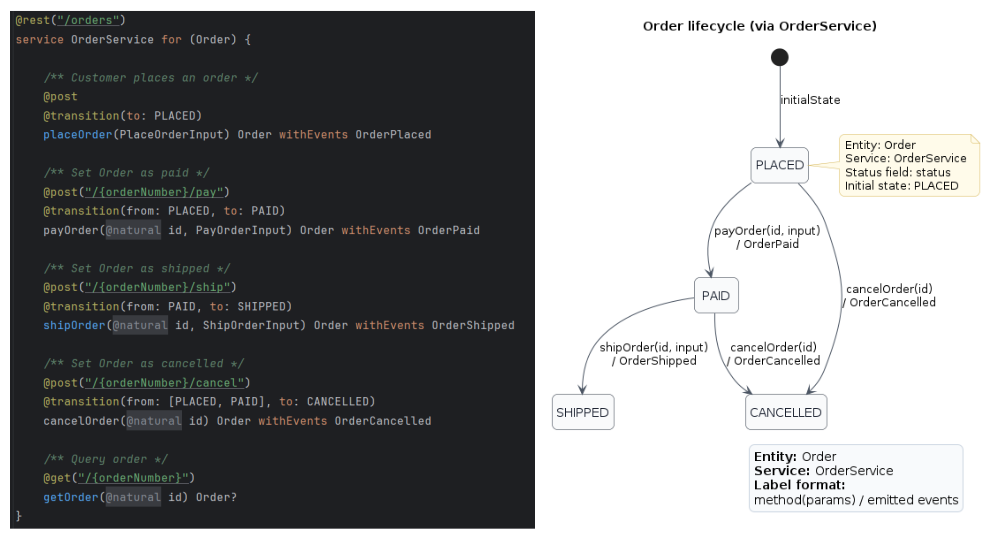
And lifecycle diagrams in PlantUML, so the model documents itself.
But the thing I like most is this: it works without forcing a specific implementation style. You can start with lightweight aggregates today and move to rich aggregates later. The lifecycle model stays the same.
Define the rules once. Let the generator do the rest. That is the whole idea.
Example: From DSL to Code
This is not just documentation. The state machine is enforced in the generated code.
@rest("/orders")
service OrderService for (Order) {

    /** Customer places an order */
    @post
    placeOrder(PlaceOrderInput) Order withEvents OrderPlaced

    /** Set Order as paid */
    @post("/{orderNumber}/pay")
    @transition(from: PLACED, to: PAID)
    payOrder(@natural id, PayOrderInput) Order withEvents OrderPaid

    /** Set Order as shipped */
    @post("/{orderNumber}/ship")
    @transition(from: PAID, to: SHIPPED)
    shipOrder(@natural id, ShipOrderInput) Order withEvents OrderShipped

    /** Set Order as cancelled */
    @post("/{orderNumber}/cancel")
    @transition(from: [PLACED, PAID], to: CANCELLED)
    cancelOrder(@natural id) Order withEvents OrderCancelled

    /** Query order */
    @get("/{orderNumber}")
    getOrder(@natural id) Order?
}
Here is the lifecycle for the previous example in PlantUML:
@startuml
title Order lifecycle (via OrderService)

hide empty description
skinparam shadowing false
skinparam BackgroundColor white
skinparam ArrowColor #4B5563
skinparam StateBorderColor #1F2937
skinparam StateFontColor #111827
skinparam StateBackgroundColor #F9FAFB
skinparam StateStartColor #111827
skinparam StateEndColor #111827
skinparam NoteBackgroundColor #FFFBEA
skinparam NoteBorderColor #D6B656
skinparam LegendBackgroundColor #F8FAFC
skinparam LegendBorderColor #CBD5E1
skinparam roundcorner 12

state "PLACED" as PLACED
state "PAID" as PAID
state "SHIPPED" as SHIPPED <<terminal>>
state "CANCELLED" as CANCELLED <<terminal>>

[*] --> PLACED : initialState

PLACED --> PAID : payOrder(id, input)\n/ OrderPaid
PAID --> SHIPPED : shipOrder(id, input)\n/ OrderShipped
PLACED --> CANCELLED : cancelOrder(id)\n/ OrderCancelled
PAID --> CANCELLED : cancelOrder(id)\n/ OrderCancelled

note right of PLACED
Entity: Order
Service: OrderService
Status field: status
Initial state: PLACED
end note

legend right
  <b>Entity:</b> Order
  <b>Service:</b> OrderService
  <b>Label format:</b>
  method(params) / emitted events
endlegend
@enduml
And this is the kind of code generated from the DSL:
override fun cancelOrder(orderNumber: String): Order {
    log.debug("Request cancelOrder: {}", orderNumber)

    val existingOrder =
        orderRepository.findByOrderNumber(orderNumber)
            ?: throw NoSuchElementException("Order not found with id: orderNumber=$orderNumber")
    // Transition validation
    requireState(existingOrder.status, OrderStatus.PLACED, OrderStatus.PAID)
    existingOrder.status = OrderStatus.CANCELLED
    val order = orderRepository.save(existingOrder)

    // emit events
    eventsProducer.onOrderCancelled(eventsMapper.asOrderCancelled(order))
    return order
}
The transition is validated, the state is updated, and the domain event is emitted. All derived from the model.
If you want to see the full example: